一、作業前準備與整機檢查
(一)安全與環境檢查
- 清理操作區域雜物,預留 1 米以上安全操作空間,確保進料口、濾液出口、卸料區無堵塞。
- 檢查電氣系統:電源連接牢固、接地可靠,電控箱密封完好無積水,急停按鈕靈敏有效;冬季作業需空載預熱液壓站 10-15 分鐘,待油溫升至 15℃以上再啟動。
- 檢查液壓系統:確認液壓油位在刻度線中間位置,油質無乳化、無雜質;液壓管路無泄漏、接頭無松動,壓力表量程匹配且校驗合格。
(二)核心部件檢查
- 濾板與濾布:核對濾板數量與型號,排列整齊無錯位,密封面無劃痕、無物料殘留;濾布安裝平整無褶皺、無破損,邊緣密封嚴實,濾布孔徑需與物料顆粒匹配,避免漏料。
- 隔膜系統:檢查隔膜濾板充氣 / 充液通道通暢,壓榨閥門開關靈活,無漏氣、漏液現象。
- 拉板系統:自動拉板小車運行順暢,拉爪無磨損變形;手動拉板需確認手柄牢固,兩側施力均勻。
二、核心操作流程
(一)濾板壓緊
- 啟動液壓站,按下 “壓緊” 按鈕,驅動壓緊板緩慢移動,逐步貼合濾板組。
- 觀察壓力表,當油壓達到設備額定壓緊壓力(通常 0.8-1.5MPa,嚴禁超壓)時,切換至 “保壓” 模式,確保濾室密封嚴密,無物料泄漏風險。
- 嚴禁在濾板未完全壓緊、保壓未到位時啟動進料,避免物料噴濺、濾板移位損壞。
(二)藥劑調配(針對污泥 / 細顆粒物料)
- 向 2 噸藥劑桶注入清水,開啟攪拌電機,按 “少量多次” 原則投加 PAM 絮凝劑(常規配比約 10 斤藥劑 / 2 噸水),持續攪拌至藥劑完全溶解。
- 觀察藥劑溶液狀態,確認無結塊、無分層,與水充分混合后備用;攪拌電機需全程開啟,直至藥劑投加完成。
(三)物料絮凝預處理
- 開啟污泥泵向 5 噸沉淀罐送料,同時開啟沉淀罐攪拌電機,啟動藥劑加藥泵,將調配好的藥劑水緩慢注入罐中。
- 觀察物料絮凝狀態,少量多次投加藥劑水,直至料漿中出現明顯小絮花、固液分離清晰后,關閉加藥泵與沉淀罐攪拌電機;物料濃度越高,藥劑量需相應增加,反之則減少。
(四)進料過濾
- 開啟進料泵,先將進料閥調至 1/3 開度,小流量向壓濾機送料,從第一個水龍頭開始逐步打通管路,待濾布均勻掛料后,緩慢加大進料流量。
- 控制進料壓力在 0.4-0.6MPa(嚴禁超 0.45MPa),實時觀察沉淀罐料位,料位不足時及時關停進料泵,避免空轉損壞設備。
- 監控濾液澄清度,若濾液渾濁,立即停機檢查濾布是否破損;若壓力驟升,說明濾布堵塞,需及時清理或更換。
(五)隔膜壓榨
- 進料完成后,關閉進料泵與進料閥,啟動二次壓榨泵,向隔膜濾板通入壓榨介質(壓縮空氣或高壓水)。
- 控制升壓速度≤0.1MPa/min,壓榨壓力比進料壓力高 0.2-0.5MPa,保壓脫水 40 分鐘 – 1 小時,期間觀察水流量,直至出液量顯著減少。
- 打開回流閥門,將隔膜腔余水全部回流至清水罐,保壓 10 分鐘后關閉閥門,完成壓榨工序;嚴禁瞬間泄壓,避免濾板回彈變形。
(六)卸餅操作
- 將操作箱切換至 “自動” 模式,按下 “松開” 按鈕,使壓緊板退回至限位位置,完全松開濾板。
- 啟動自動拉板裝置,小車逐塊拉開濾板,濾餅靠自重落入集料斗,直至拉完最后一塊板后,復位壓緊壓濾機,進入下一個循環。
- 若濾餅粘連濾板,需用木鏟、塑料鏟等軟質工具輕輕剝離,嚴禁用金屬工具刮擦濾板密封面,避免劃傷影響密封效果;操作時嚴禁將頭、手伸入濾板間隙,防止夾傷。
三、日常保養與維護
- 潤滑保養:沉淀罐攪拌電機、藥劑桶攪拌電機每月加注一次潤滑油;拉板小車導軌、軸承等運動部件每周加注潤滑脂,確保運行順暢。
- 液壓系統維護:液壓油每半年至一年更換一次,補充至規定油位;定期清洗油箱濾芯,檢查油缸密封圈,及時更換老化密封件,避免漏油。
- 濾布與濾板清潔:每次卸餅后,徹底清理濾布、濾板上的殘留物料,確保濾布孔隙通暢、濾板密封面干凈;濾布堵塞時,用高壓水反沖清洗,破損面積超 5cm2 需立即更換。
- 設備清潔:及時清理小車軌道上的雜物,避免卡阻;用清水沖洗進料管、出液管,防止物料殘留硬化堵塞管路。
- 長期停機保養:排空設備內殘留液體,給濾板涂防銹油,濾布清洗晾干后封存,用防雨布覆蓋整機,避免日曬雨淋、銹蝕損壞。
四、安全操作注意事項
- 嚴禁超壓、超溫運行,過濾壓力不得超過 0.45MPa,物料溫度不得超過 80℃,防止濾板變形、爆裂。
- 設備運行時,不得進行濾板拆卸、維修、清理作業;出現異常異響、漏油、濾板破裂等情況,需立即按下急停按鈕,先泄壓再排查故障。
- 操作人員需經專業培訓上崗,佩戴防護手套、護目鏡等勞保用品,規范操作流程,杜絕違規作業。
- 定期檢查安全防護裝置,確保液壓系統安全閥、電控箱漏電保護器等靈敏有效,保障生產安全。
板框過濾布目數選擇與微米對照說明
板框過濾布廣泛應用于:
? 鎳精礦
? 銅精礦
? 污泥脫水
? 冶金行業
? 化工行業
在實際選型過程中,客戶普遍習慣使用“目數”作為過濾精度的判斷依據。
一、什么是目數(Mesh)?
**目數(Mesh)**是指:
每英寸(25.4mm)長度內的孔數
目數與過濾精度關系如下:
? 目數越大 → 孔徑越小 → 過濾越精細
? 目數越小 → 孔徑越大 → 過濾通透性越強
二、常見目數與微米對照參考
根據行業通用篩網目數—微米對照表,部分常用參數如下:
目數(Mesh) 孔徑(μm)
60目 246μm
80目 198μm
100目 165μm
110目 150μm
180目 83μm
200目 74μm
250目 61μm
270目 53μm
325目 47μm
425目 33μm
500目 25μm
625目 20μm
800目 15μm
可以看到:
? 100目 ≈ 165微米(中等過濾)
? 200目 ≈ 74微米(精細過濾)
? 500目 ≈ 25微米(高精度過濾)
? 800目 ≈ 15微米(超精細過濾)
在板框壓濾應用中,常見目數一般在 100目—800目 之間。
三、不同工況如何選擇目數?
目數選擇需要結合以下因素:
1?? 物料粒徑
? 粗顆粒 → 100–150目
? 中等顆粒 → 150–300目
? 細顆粒或高要求 → 300目以上
2?? 過濾速度要求
? 追求通量 → 低目數
? 追求清液清澈度 → 高目數
3?? 濾餅含水率要求
? 高壓脫水工況 → 建議中高目數配合合理織造結構
4?? 行業參考
行業 常見目數區間
銅/鎳精礦 150–300目
污泥脫水 100–200目
化工精細過濾 300–500目
(具體仍需根據物料粒徑分布測試確定)
四、常見板框過濾布型號
常見型號包括:
? 丙綸750系列(750A / 750B / 750AB)
? 丙綸108C
? 丙綸840AB
? 滌綸621
? 滌綸3927
? 錦綸6533
不同材質區別:
材質 特點
丙綸 耐酸堿、性價比高
滌綸 強度高、耐磨
錦綸 彈性好、耐沖擊
五、丙綸濾布優勢
蘇東壓濾機丙綸系列濾布已通過檢測認證,符合法規多項檢測標準。
特別適用于:
? 大過濾面積臥式壓濾機
? 多室結構設備
? 密封要求高的工況
可有效解決:
? 密封差
? 漏料
? 濾布變形
并具備:
? 供貨穩定
? 專業硫化技術團隊支持
? 高性價比
六、選型核心建議
目數 ≠ 唯一標準
板框過濾布選型應綜合:
? 目數(微米)
? 織造結構
? 單絲/復絲結構
? 克重
? 厚度
? 透氣量
? 設備壓力
真正實現:
濾布與設備的完美匹配
蘇東壓濾機濾布
]]>A large-scale enterprise, with three newsprint production lines and a whiteboard production line, while supporting the construction of a 30,000t / d and a 15,000t / d sewage treatment system. As a result of the use of all waste paper for deinking pulp, so the loss of short fibres in the pulping process and waste paper in the dust, ink and other materials in the production process along with the discharge of production wastewater into the back of the sewage treatment system, which produces a large amount of sewage sludge. The traditional process generally adopts double-net filter press for sludge gravity dewatering after landfill or composting, but due to the lower dewatering efficiency of double-net filter press, the water content of the treated sludge still reaches about 75%, so the volume of sludge is huge, and it needs to take up a large amount of land resources for landfill, and generates a large amount of transport and treatment costs and is prone to cause secondary pollution. As the national environmental protection requirements become more and more stringent and the land resources are reduced, the supervision of solid waste is getting stronger and stronger, and it must be handled by qualified professional units and supervised throughout the whole process, so the treatment cost increases significantly. In order to long-term development, the company uses the opportunity of retreating from the second into the third, environmental protection relocation, the construction of the plate and frame filter press, the sludge of the sewage treatment system for deep dewatering, and supporting the construction of the comprehensive utilization of waste residue power plant, specializing in the incineration of deep dewatering of sewage sludge, so as to achieve harmless treatment and the purpose of resource recycling (Note: the company's sewage sludge contains a certain amount of fibers and inks, depth). (Note: Our sewage sludge contains a certain amount of fibre and ink, which can be recycled after deep dewatering and still contains a certain amount of heat).
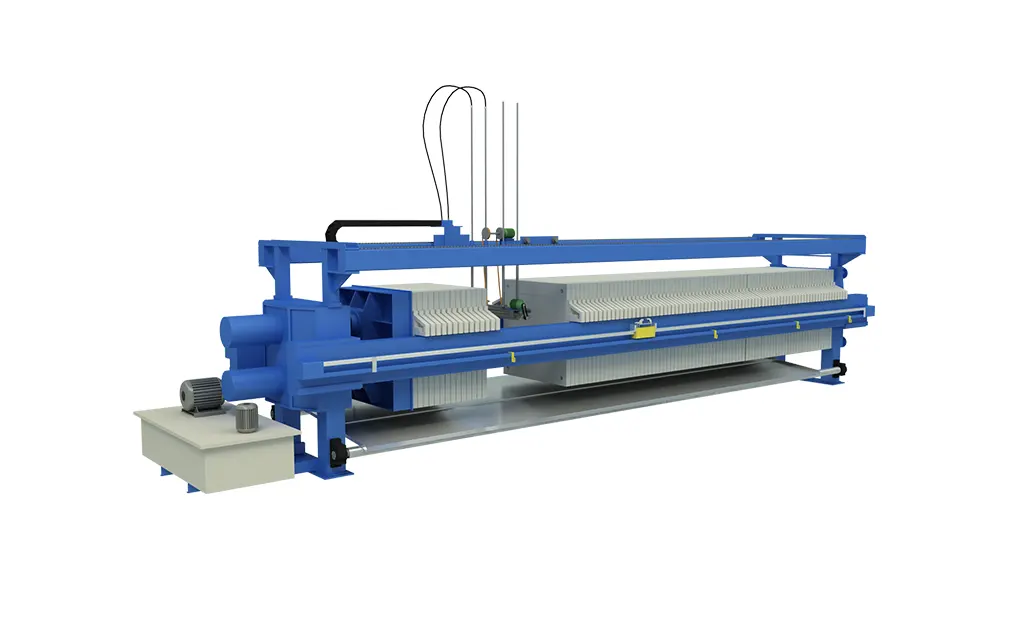
2 Diaphragm type plate and frame filter press working principle
The sludge deep dewatering equipment used isFully automatic diaphragm type plate and frame filter presses。全自動隔膜壓濾機是一種問歇性的加壓過濾設備,可用于各種懸浮液的固液分離。該設備脫水的原理主要是通過高壓進料及高壓壓榨,在壓力作用下,濾室內懸浮液里的水分透過濾布進入濾液側,而固體顆粒則在濾布的截流下保留在濾室里,從而實現固液分離的目的。板框壓濾機配備的濾板分為隔膜板和框板,兩種板間隔布置。隔膜板內腔中空,具有一定的膨脹性,而框板為硬板實心設計,起頂壓作用。當壓榨液注入隔膜板的內腔后,在壓力作用下隔膜板逐漸鼓脹,濾室的體積越來越小,從而進一步將濾室內的污泥水分擠壓出來。壓濾機的運行為間歇性進料,一個周期主要包括進料、壓榨、排水、卸料幾個步驟。隔膜式板框壓濾機處理的污泥水分含量一般能達到50%以下,其干度與高壓進料壓力及壓榨壓力相關,但綜合考慮運行的經濟性及設備的安全性,設計時選高壓進料壓力及壓榨壓力為1.6MPa,污泥干度為50%~60%。
3 System design and operation and maintenance
The sewage filter press treatment system is a three-stage treatment process, the process is: physical sedimentation a (Ic anaerobic + SBR aerobic) biochemical treatment a shallow air flotation, so the sludge produced by the system in addition to the physical sludge produced by the sedimentation, and the residual sludge produced by the biochemical treatment of the SBR and air flotation sludge. The process of sludge treatment system is as follows: the physical sludge from the sedimentation tank and the residual biochemical sludge from SBR enter the sludge thickener for thickening, and then sent to the filter press for treatment. The air flotation sludge, however, is directly into the sludge conditioning tank because it combines a large number of fine bubbles with low specific gravity, which makes it difficult to be thickened by gravity settling. The thickening tank has a buffer and can be processed intermittently, but the air flotation, due to continuous operation, produces sludge continuously and enters the sludge mixing tank continuously. The plate and frame filter press is an intermittent feed, with the change of operating conditions, the sludge handling capacity will change, so the sludge concentration in the conditioning tank will fluctuate, and the flocculation effect of the chemicals will also fluctuate, which will cause interference in the normal operation of the filter press. In view of the above problems, we have focused on optimisation in the system design.
3.1 Increase pre-dewatering facilities Plate and frame filter press dewatering system design in the past is generally a variety of sludge into the sludge conditioning tank mixing and dosing conditioning by the feed pump into the plate and frame filter press filter dewatering. The concentration of the feed depends on the mixing concentration of the various sludges entering the conditioning tank. Air flotation sludge is difficult to be concentrated by conventional gravity concentration method due to carrying fine air bubbles and low specific gravity, therefore, the system is generally designed to send the air flotation sludge directly into the sludge mixing tank for dewatering. Due to the low concentration of air-float sludge, and due to the carrying of small bubbles, the mud quality is relatively loose, so when the proportion of air-float sludge is larger, the concentration of mixed sludge will be lower and the dewatering effect is poor, and it is easy to be adsorbed on the surface of the filter cloth and block the filter channel of the filter cloth. In order to eliminate the influence of sludge concentration fluctuation on the operation, we designed a gravity bed for pre-dewatering before the sludge conditioning tank. The principle of gravity bed is: after flocculation, the suspension enters the gravity bed, and under the effect of gravity, the external water of the material is discharged through the filter screen into the collecting tank, while the concentrated material after preliminary dewatering stays on the filter screen, and then enters the next process after conveying. After coagulation of the suspension through the gravity bed dewatering, the concentration is raised to 5% 10%, and then into the plate and frame filter press system, which can greatly improve the efficiency of the plate and frame filter press.
3.2 Optimise the dosing system plate and frame treatment system design generally set the dosing point in the sludge conditioning tank, that is, the agent is added directly in the sludge conditioning tank stirring flocculation. In order to ensure the flocculation effect and stable material quality, the general system will be designed with two conditioning tanks, but need to occupy a lot of space, in addition, the operation and control requirements are higher. Due to the site constraints of our company, it is difficult to arrange two sludge conditioning tanks, so we chose to use one conditioning tank in the system design and borrowed the original sludge mixing tank of the system as a transfer tank. In order to eliminate the influence of sludge composition fluctuation on pharmaceutical flocculation, we adjusted the flocculant addition point. After mapping and drawing on previous operating experience, we adopted a pipe mixer for flocculation dosing and set the dosing point on the pipe in the range of (3-5) m before entering the gravity bed. The flocculant and material in the pipeline after (2~3)S rapid mixing, flocculation reaction into the gravity bed. As the inlet of gravity bed is open, the flocculation effect of materials can be observed at any time, so the dosage of chemicals can be adjusted in time according to the flocculation effect of materials and changes in the composition to ensure good flocculation effect and to lay the foundation for the normal dewatering of the plate and frame filter press in the latter part of the process.
3.3 Mixer form selection material after gravity bed pre-dewatering, the concentration greatly increased from the operating data, mixed sludge concentration from 1.5 to 3 per cent before dewatering to 5 to 7 per cent, the plate and frame machine processing capacity greatly increased. However, after increasing the concentration, the fluidity of the material deteriorates, therefore, in order to ensure that the material enters the plate and frame with uniform concentration, but also to avoid flocs being dispersed again due to excessive mixing efforts, so the design of the plate and frame machine into the mud pool configuration of the mantle speed mixer, vertical mounting, rotational speed is selected as (5-8) r/min, so that the high concentration of the material mixing and homogeneity of the material into the filtering system smoothly.
3.4 System operation and maintenance Plate and frame filter press adopts polypropylene monofilament woven mesh as the filter bag, and there is a gap between the mesh and the mesh of the prepared mesh, the material is squeezed under high pressure, and the liquid in the material enters into the filtrate area through the gap between the mesh and the mesh, and the sludge is detained in the mesh bag. In order to facilitate the collection of filtrate, the surface of the frame plate is designed with a raised nail point, and the filtrate is collected by the concave channel between the nail points and discharged into the main collecting pipe. However, due to the high operating pressure, the fine particles in the material will partially penetrate the filter cloth into the filtrate side, and deposit in the concave channel of the frame plate. et accumulates, the concave channel will be blocked by the piled up particles, and the disappearance of concave and convex points causes the frame plate to be poorly drained, which will have a certain impact on the filtration efficiency of the filter cloth. Although the plate and frame machine is equipped with an online cleaning machine, the cleaning machine can not clean the accumulated mud on the filter plate, so it is necessary to regularly clean the filter cloth and frame plate offline. Cleaning method is to stop the filter press offline, remove the filter cloth, the use of high-pressure water gun on the exposed filter plate piece by piece rinsing, will be deposited in the concave channel sludge cleaning off, to restore the hydrophobic channel of the frame plate. Similarly, the filter cloth is also sprayed on both sides using a high-pressure water gun. If the filter cloth is scaled, it can also be soaked in citric acid and then rinsed with high-pressure water to restore the filtering capacity of the cloth. The general cleaning cycle is four months. Because the filter cloth is a consumable product, the general use of the cycle is four months, and the use of offline cleaning, the use of the cycle can be extended to 9 ~ 10 months, greatly reducing operating costs.
4 Conclusion The diaphragm-type plate and frame filter press system, through reasonable system design and effective operation and management, can give better play to the depth dewatering efficiency of the equipment, so that the dryness of the sludge reaches more than 50%, which is directly sent to the boiler for incineration, providing technical support for the reduction and harmless treatment of solid wastes, as well as laying a solid foundation for the enterprise to achieve the energy-saving and environmental protection goals.
Disclaimer: The copyright of this article belongs to the original author and the original source.
Welcome to call us for consultation, technical exchange, and material experiment.
Non-woven filter cloth high strength pressure, filtration accuracy up to 4 microns or less, the product can be provided according to user needs of polypropylene and polyester two kinds of raw materials.
Applications:
It is used in coal beneficiation, printing and dyeing, pharmacy, beer, chemical industry, dyestuff, iron and steel, construction, iron treatment, chemical industry, ceramics, cement, geology, minerals and other industries.
Quality Assurance:
The goal is to ensure the quality of the product, using the system, all-round testing.
Reasonably priced:
With excellent products, reasonable price, to achieve the product increasebe on dutyObjective.
Honest co-operation:
Over the decades, we have earned a reputation for integrity and won the market.
Sales:181-181-000-11
Selection:188-517-18-517
Mailbox:suton@su-ton.com
]]>Brushed Filter ClothIncreasing the sealing of the filter cloth border is conducive to improving the operating conditions, reducing the loss of valuable materials, and reducing the leakage of toxic, hazardous, flammable and explosive volatile gases and other advantages.
Applications:
It is used in coal beneficiation, printing and dyeing, pharmacy, beer, chemical industry, dyestuff, iron and steel, construction, iron treatment, chemical industry, ceramics, cement, geology, minerals and other industries.
Quality Assurance:
The goal is to ensure the quality of the product, using the system, all-round testing.
Reasonably priced:
With excellent products, reasonable price, to achieve the product increasebe on dutyObjective.
Honest co-operation:
Over the decades, we have earned a reputation for integrity and won the market.
Sales:181-181-000-11
Selection:188-517-18-517
Mailbox:suton@su-ton.com
]]>Polyester long fibre filter cloth has smooth surface, good abrasion resistance, high strength, higher strength and better abrasion resistance through twisting, thus the fabric has good air permeability, fast water leakage and easy to clean.
Applications:
Polyester filter cloth use: pharmaceutical, food, chemical, metallurgy, printing and dyeing, beer, chemical, dyestuff, steel, construction, iron treatment, chemical, ceramics, cement, geology, minerals and other industries.
Quality Assurance:
The goal is to ensure the quality of the product, using the system, all-round testing.
Reasonably priced:
With excellent products, reasonable price, to achieve the product increasebe on dutyObjective.
Honest co-operation:
Over the decades, we have earned a reputation for integrity and won the market.
Sales:181-181-000-11
Selection:188-517-18-517
Mailbox:suton@su-ton.com
]]>Polypropylene filter cloth has excellent alkali resistance, excellent strength, elongation and abrasion resistance, good chemical stability and good moisture absorption resistance;
Applications:
Used in chemical industry, ceramics, pharmaceuticals, smelting, manufacturing, ore dressing, etc.
Quality Assurance:
The goal is to ensure the quality of the product, using the system, all-round testing.
Reasonably priced:
With excellent products, reasonable price, to achieve the product increasebe on dutyObjective.
Honest co-operation:
Over the decades, we have earned a reputation for integrity and won the market.
Sales:181-181-000-11
Selection:188-517-18-517
Mailbox:suton@su-ton.com
]]>